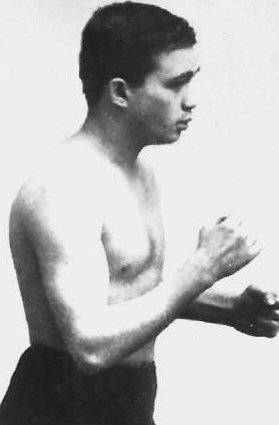
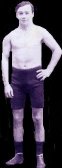
 Percy Jones held the World title for only a short time; and
boxed in an era that included probably the greatest flyweight of
all time in Jimmy Wilde - who, as stated, lived just up the road
in Tylorstown. Tragically, Percy died at a young age, he was
just 29 years old when he succumbed to Trench fever. It may be
any one (or all) of these reasons that Percy's name is rarely
mentioned amongst any list of Welsh boxing greats - which is to
do the man a great disservice. He was a GREAT Welsh boxer and
the country's first World champion. He also beat the best of his
day - and there were many, many fine boxers around during
Percy's career. A comparison of Percy's record with that of
Jimmy Wilde's will show many of the same names - with the
Rhondda fighters usually coming out on top.
Percy Jones held the World title for only a short time; and
boxed in an era that included probably the greatest flyweight of
all time in Jimmy Wilde - who, as stated, lived just up the road
in Tylorstown. Tragically, Percy died at a young age, he was
just 29 years old when he succumbed to Trench fever. It may be
any one (or all) of these reasons that Percy's name is rarely
mentioned amongst any list of Welsh boxing greats - which is to
do the man a great disservice. He was a GREAT Welsh boxer and
the country's first World champion. He also beat the best of his
day - and there were many, many fine boxers around during
Percy's career. A comparison of Percy's record with that of
Jimmy Wilde's will show many of the same names - with the
Rhondda fighters usually coming out on top.
As with most Welsh fighters of the time, Percy began his
interest in boxing by participating in the many boxing booths of
the day. As these bouts were largely unrecorded we will never
know the exact number of fights that Jones undertook before
turning professional in 1911.
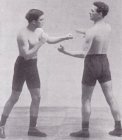 The
future world champ's first pro bout was an unexciting 6 round draw
against Young Roberts, which took place locally, in Pentre. Indeed,
Percy's first ten contests resulted in eight wins and two draws which
belied the skilfulness of Jones boxing - after all he was trained by
none other than 'Peerless' Jim Driscoll. A fast, powerful fighter with
a solid punch, at flyweight, Jones then went on to record an unbeaten
record of 41 fights (39 wins - 2 draws) before his successful challenge
for the World flyweight title.
The
future world champ's first pro bout was an unexciting 6 round draw
against Young Roberts, which took place locally, in Pentre. Indeed,
Percy's first ten contests resulted in eight wins and two draws which
belied the skilfulness of Jones boxing - after all he was trained by
none other than 'Peerless' Jim Driscoll. A fast, powerful fighter with
a solid punch, at flyweight, Jones then went on to record an unbeaten
record of 41 fights (39 wins - 2 draws) before his successful challenge
for the World flyweight title.
To take the title Percy had to travel up to London to face New
Cross's, Bill Ladbury. The Englishman had taken the title from
the flyweight division's first ever World champion Sid Smith,
by way of an 11th round stoppage the previous year. In doing so
Ladbury also rightfully claimed the British & European titles.
The talented Welshman - without a title to his name - was up
against a three belt champion and fighting in his opponents own backyard.
In a hard battle over
20 rounds the disadvantages were overcome, as Wales' Percy Jones took
a convincing points victory, to become
British, European & World Flyweight Champion.
In his first bout, the following month, after becoming Wales
first ever World champion, Jones lost a 15 round points decision
to Eugene Criqui in a non-title fight. To set the record
straight as to who was the better man, a second bout was
arranged just six weeks later. This time Percy's European &
World titles were at stake. With his precious titles on the
line, Jones made no mistake in securing a sound 20 rounds points
decision.
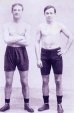 Increasingly, Percy had been finding it difficult to make the
flyweight limit so engaged in catchweight non-title bouts, with
mixed fortunes. Indeed, after his win against Criqui, the Porth
fighter never again made the flyweight limit. Although Joe
Symonds and Tancy Lee were both victorious against Jones
and subsequently claimed his titles, Percy never actually lost
his titles in the ring as these bouts took place over the
flyweight limit.
Jones moved up to bantamweight but his career was cut short with
the outbreak of the Great War.
Increasingly, Percy had been finding it difficult to make the
flyweight limit so engaged in catchweight non-title bouts, with
mixed fortunes. Indeed, after his win against Criqui, the Porth
fighter never again made the flyweight limit. Although Joe
Symonds and Tancy Lee were both victorious against Jones
and subsequently claimed his titles, Percy never actually lost
his titles in the ring as these bouts took place over the
flyweight limit.
Jones moved up to bantamweight but his career was cut short with
the outbreak of the Great War.
His last contest was a fifth
round KO of the man he took the World title from, Bill Ladbury,
in 1915. In his short, illustrious career Percy Jones had
reached the pinnacle of his sport and established himself as one
of Wales finest ever boxers.
Serving as a
Sergeant, in the Royal Welsh Fusiliers, Percy was severely wounded in the leg (1916) and also badly
affected by poison gas. After undergoing almost 30 operations, his leg was
amputated two years later.
In
1922 Percy made a rare appearance, at the Nazareth House Orphanage in
Cardiff. His weight was down to 4st 2lbs. Sadly, he died of Trench
fever on Christmas Day that year, just 29 years of age.
Brave both inside of a boxing ring and outside of it, Percy
Jones was one of the greats.